

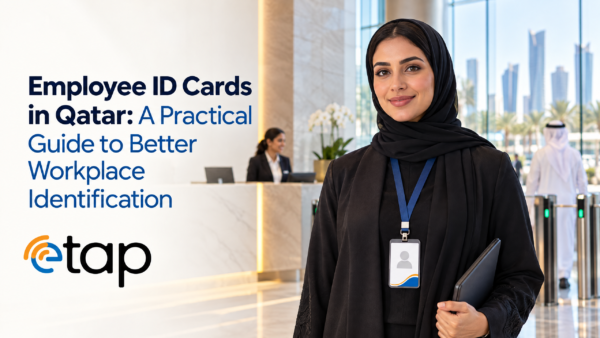
Employee identification is a small part of workplace administration, but it has an important effect on security, organisation, and the daily experience of staff and visitors. In Qatar, businesses across offices, retail, hospitality, healthcare, education, construction, and facilities management rely on clear identification to help people recognise authorised personnel and understand their roles. A well-planned employee ID card programme gives an organisation a consistent way to identify its team while supporting wider access and attendance procedures.
Why employee ID cards matter
An employee ID card provides a visible link between a person and the organisation they represent. At reception areas, work sites, and shared facilities, displaying a card can help colleagues, customers, contractors, and security teams identify staff more easily. Cards can also support a professional appearance by applying the same logo placement, colours, typography, and information structure across the workforce.
Identification is particularly useful in environments where employees move between departments or locations. A clearly displayed card can help distinguish employees from visitors and contractors. It does not replace staff training, supervision, or formal security procedures, but it adds a practical layer of everyday identification.
What information should an employee card include?
The information printed on a card should be selected according to the organisation’s needs and privacy policies. Common fields include the employee’s name, photograph, job title or department, company name, and a unique employee number. Some organisations include an expiry date or a contact point for returning a lost card. Keep the layout readable: a card overloaded with text is harder to identify quickly.
Before printing, confirm spelling, job titles, photographs, and employee numbers against an approved staff list. Decide who can request changes and who gives final approval. This simple checking process helps prevent reprints and reduces the risk of incorrect credentials being issued.
Choosing PVC cards and a suitable design
PVC is widely used for employee identification because it is lightweight, practical, and suitable for everyday carrying. When selecting a card, consider its thickness, print quality, finish, durability, and how it will be worn. A portrait photograph should be clear, while the organisation’s name and key identification details should remain legible at normal viewing distance.
Consistency matters more than decoration. Use brand colours carefully, maintain sufficient contrast, and reserve prominent space for the photograph and name. If different departments need different visual identifiers, use a controlled colour band or department label rather than creating unrelated card designs.
Printed identification and electronic access
A printed ID card and an electronic access credential are not automatically the same thing. Some cards are used only for visual identification; others contain a chip or technology that works with a compatible access-control, attendance, or membership system. Before choosing a technology, ask the system provider which card type, frequency, chip, and encoding format are supported.
Do not assume that every PVC card can unlock a door or record attendance. Integration requires compatible readers, software, credential configuration, and appropriate permissions. Organisations should also have a process to deactivate lost or expired credentials where electronic access is involved.
A simple implementation process
Start by identifying the purpose of the programme: visual identification, access control, attendance, or a combination. Next, check the requirements of any existing readers and software. Prepare a staff data template, approve the card design, and test a sample before placing a larger order. Keep a controlled record of cards issued, returned, replaced, and deactivated.
Plan for new starters, role changes, leave, and departures. A card should be updated or cancelled when a person’s status changes. Store employee photographs and personal information securely, limit access to authorised staff, and avoid printing sensitive information that is not needed for identification.
Working with a Qatar card supplier
When comparing suppliers, look beyond the headline price. Ask about print quality, card material, design support, minimum quantities, turnaround time, replacement orders, and whether electronic encoding is available when required. Share the technical requirements of your access-control system before ordering any chip-enabled cards. A supplier should be able to explain what is included and what depends on third-party equipment or software.
Conclusion
Employee ID cards help Qatar organisations build a more organised and recognisable workplace. By choosing a clear design, checking employee data carefully, and matching any electronic features to the organisation’s systems, businesses can create an ID programme that is practical and easy to maintain. For businesses comparing options, explore etap’s PVC employee ID cards in Qatar.
For a smooth rollout, document the process and review it periodically. Ask staff what questions employees and visitors raise, check whether the cards remain readable after daily use, and update the design when the organisation changes its branding or structure. A consistent process makes it easier to manage replacements and maintain accurate records.